
Description
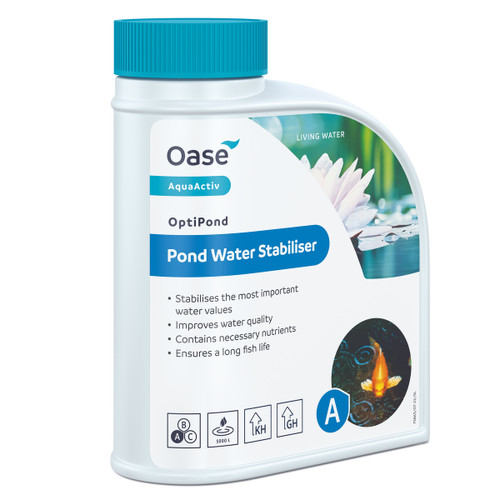
OptiPond is a pond stabiliser that creates optimal water conditions and stabilises the most important parameters.
Key Features
- Stabilises the most important water values
- Improves water quality
- Ensures a long fish life
- Contains necessary nutrients
Rain water or well water which is low in minerals is treated in accordance with pond conditions.
OptiPond stabilises the carbonate hardness and total hardness of the water and protects the pond from a dangerous drop in acidity. It binds pollutants such as ammonium and ammonia gas.
The balanced formulation is based on natural conditions and produces a balance of important trace elements such as sodium, potassium, calcium or magnesium.
With the correct dosage, the carbonate hardness increases by +1.5 °dKH and the total hardness by +1.9 °dH.
Characteristic OPTIMISER:
- Creates optimal water conditions (KH, GH, pH) WATER TREATMENT:
- Provides precisely the right treatment for soft well water or rainwater SUPPLEMENT:
- Adds essential minerals and macro elements INSTANT HELPER:
- Helps with urgent problems caused by excessive levels of ammonia, nitrite or heavy metals in the pond
- 500ml container is suitable for pond up to 5000 litres.
Important not to underdose . We recommend using at being of spring and end of summer, two treatments per year.
Use instructions OASE AquaActiv OptiPond Pond Water Stabiliser
Soft water, rainwater and old water in garden ponds often tend to have greatly different pH values.
There are natural causes for this and are based on what is known as the day/night cycle. When
exposed to sunlight, the plants (including algae) in the pond photosynthesise and therefore consume CO2
, which increases the pH value. At night, plants, as well as animals, release CO2, which causes the pH value to decrease. Not even hard tap water or filling water can offer a solution, as these are „diluted“ by rainwater. In addition, an effective buffer depends on the ratio between calcium (GH) and carbonate species (KH). This is an even greater problem during the warmer seasons in particular due to strong algae growth, which in turns reduces the amount of carbon dioxide. As
a result, the pH value rises significantly above pH 9 and the pond organisms are harmed. For example, fish excrete ammonium as a metabolite, which becomes ammonia when it reaches a pH value of 8.5. The fish can no longer
release their own ammonium into the water and they poison themselves from within. Like ammonium, dreaded nitrite is also in a pH-dependent balancing act with nitrous acid. This is the toxic compound and is more likely to be formed at pH values below 7.
Therefore, acidifying the pond is not advisable. Drops in acidity occur most frequently when there is a high organic load from feed and strong microbial activity.
How it works:
OptiPond sets the balance of limescale and carbonic acid. It creates a latent buffer system that mitigates extreme events. Fixing the pH value between 7.5–8.5 provides a natural basis in the ecosystem. This actively prevents nitrite and ammonium poisoning.
Dosage:
Approx. 130 g (= 100 ml) per 1000 litres of pond water
Application:
Distribute OptiPond on the pond surface. We recommend a KH > 5 °dKH to ensure effective buffering and a pH value of
7.5–8.5. Slightly cloudy water indicates that too much OptiPond has been used. This cloudiness is harmless and settles after a certain time.