
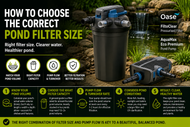
How to Choose the Correct Pond Filter Size
Published by Rockworld Water Features, Ireland on 4th Aug 2026
HOW TO CHOOSE THE CORRECT POND FILTER SIZE
A pond filter should be selected according to the conditions in the actual pond—not simply the largest pond volume printed in the product name or description.
The correct filtration system depends on pond volume, fish stocking, fish type, feeding rate, sunlight, pump flow, pipework, maintenance requirements and the amount of organic material entering the water.
This guide explains how Rockworld approaches pond-filter sizing and why two ponds containing the same volume of water may require very different filtration systems.
1. Calculate the actual pond volume
Begin with the pond’s water volume. Measurements should be taken in metres.
Rectangular pond:
Length × width × average water depth × 1,000 = pond volume in litres
For example:
4 m × 3 m × 1 m × 1,000 = 12,000 litres
For an irregular pond, divide it into simpler areas or use representative average dimensions. Use the average water depth when calculating volume—not the maximum depth at the deepest point.
If the pond has not yet been filled, remember that shelves, sloping sides, stonework and displaced volume can make the finished water volume considerably lower than a calculation based only on the maximum excavation dimensions.
A water meter used while filling provides the most reliable volume measurement. Knowing the true volume is also important when applying pond treatments or fish medication.
2. Decide what type of pond is being filtered
A manufacturer’s maximum pond-volume rating often refers to favourable conditions. The filter capacity required changes significantly when fish are present.
| Pond type | Typical filtration demand | Main considerations |
|---|---|---|
| Decorative pond without fish | Lower | Leaves, pollen, sunlight and general organic debris |
| Lightly stocked fish pond | Moderate | Fish waste, feeding, suspended solids and biological load |
| Goldfish pond | Moderate to high | Fish growth, feeding rate and increasing waste production |
| Koi pond | High | Large fish, heavier feeding, rapid growth and high oxygen demand |
| Heavily stocked koi pond | Very high | Continuous solids removal, biological capacity, oxygenation and redundancy |
Always check the manufacturer’s stated capacities for ponds without fish, ponds with fish and koi ponds. Do not assume that a filter carrying a number such as “30,000” is suitable for every 30,000-litre pond.
3. Allow for fish stocking and feeding
Fish create both solid waste and dissolved waste. The biological filter must process ammonia produced by the fish and by the breakdown of uneaten food and organic material.
The biological demand is influenced by:
- The number and size of fish
- The species of fish
- The amount and protein content of food
- Water temperature
- Dissolved oxygen
- The amount of decaying organic material
- The frequency with which the mechanical filter is cleaned
Ten small fish do not create the same load as ten mature koi. Filter sizing should anticipate future fish growth rather than only the present stocking level.
A heavily stocked or heavily fed pond may require a filter with a nominal capacity several times greater than the actual pond volume. Use the specific OASE capacity information for the relevant pond type and discuss unusually high stocking levels before purchasing.
4. Understand mechanical and biological filtration
A complete pond-filtration system normally performs two different jobs.
Mechanical filtration
Mechanical filtration removes suspended solids such as fish waste, leaves, algae and uneaten food. Removing this material promptly prevents it from breaking down within the system and adding to the biological load.
Biological filtration
Biological media provides surface area for microorganisms that convert toxic ammonia first into nitrite and then into less harmful nitrate. These microorganisms require oxygenated water and time to establish.
A filter may have a large biological capacity but still perform poorly if its mechanical stage allows excessive waste to accumulate. Likewise, excellent mechanical screening does not remove the need for adequate biological treatment.
5. Calculate the required turnover rate
Turnover rate describes how frequently the pond volume passes through the filtration system.
Required filter flow = pond volume ÷ desired turnover time
For a 12,000-litre pond:
- One turnover every two hours requires approximately 6,000 litres per hour.
- One turnover every hour requires approximately 12,000 litres per hour.
Many ornamental fish ponds are designed around a turnover of approximately once every one to two hours. Koi ponds and heavily stocked systems commonly require approximately one turnover per hour, although the correct rate depends on the filter design, fish load, pipework and pond layout.
The entire pump flow is not necessarily passing through the biological filter if part of the water is diverted to a separate waterfall, fountain or bypass. Only count the flow that actually travels through the filtration system.
6. Match the pump to the filter
The pump and filter must be selected as a system. An oversized pump can force water through a filter faster than its recommended flow rate, while an undersized pump may provide inadequate circulation and turnover.
Use the pump’s delivered flow at the installation’s operating head. The maximum flow printed on the pump is normally measured with little or no lift or pipe resistance.
Operating head includes:
- The vertical lift
- Pipe friction
- Bends and valves
- UV clarifiers
- Pressure filters
- Waterfalls and other restrictions
The selected pump must deliver the required filter flow after these losses have been allowed for, without exceeding the filter manufacturer’s recommended maximum flow.
Read our guide on how pump flow changes with operating head.
7. Allow for sunlight and organic load
A pond in full sunlight generally has a greater risk of green water than a shaded pond. Nutrients from fish waste, uneaten food, soil, fertiliser run-off and decaying vegetation can increase algae growth.
Additional capacity should be considered where the pond:
- Receives prolonged direct sunlight
- Contains many fish
- Is heavily fed
- Receives leaves or garden debris
- Has limited planting
- Receives nutrient-rich surface water
- Operates at higher summer temperatures
A filter should not be expected to compensate for severe overstocking, excessive feeding, poor circulation or large amounts of decaying organic material.
8. Choose the correct UV clarifier
A UV clarifier helps control the free-floating algae responsible for green water. It does not replace mechanical or biological filtration.
UV selection depends on pond volume, flow rate, sunlight, fish load and the manufacturer’s recommendations. The water must pass through the UV unit within its permitted flow range to receive effective exposure.
A larger pond, heavy fish load or sunny location may require greater UV capacity than a lightly stocked shaded pond of the same volume.
Browse Rockworld’s OASE UV clarifiers.
9. Choose the appropriate filter type
In-pond filters
In-pond filtration sets combine a pump, filter media and usually a UV clarifier in one compact unit. They are most suitable for smaller ponds where simple installation is important.
OASE Filtral systems can provide filtration, circulation and a fountain from one underwater unit.
View in-pond filtration systems.
Pressure filters
Pressure filters remain sealed while operating, allowing the filtered water to continue uphill to a waterfall or stream. They can often be partially buried, making them easier to conceal beside a landscaped pond.
OASE BioPress systems are suited to smaller and medium applications, while OASE FiltoClear pressure filters provide higher-performance filtration and convenient cleaning options across a wider range of pond sizes.
Pressure filters add resistance to the pump circuit, so pump selection must allow for the filter, pipework and vertical lift.
View OASE pressure pond filters.
Flow-through filters
A flow-through filter is normally installed above the pond water level. Water is pumped into the filter and returns to the pond by gravity.
These systems can provide substantial mechanical and biological capacity and are often easier to inspect and maintain. OASE ranges include BioSmart, BioTec ScreenMatic and BioTec Premium systems.
View OASE flow-through pond filters.
Gravity-fed and advanced koi filtration
In a gravity-fed system, pond water enters the filter through large-diameter pipework from bottom drains or skimmers. A pump positioned after the filter returns the cleaned water to the pond.
OASE ProfiClear systems are intended for larger ponds and demanding koi applications. Correct levels, pipe sizing, flow balance, waste drainage and access for maintenance are essential.
Gravity-fed systems should be designed as complete hydraulic installations rather than selected solely from a nominal pond-volume figure.
Quick filter-selection guide
| Installation requirement | Filter type to consider |
|---|---|
| Small pond with the simplest possible installation | OASE in-pond filtration set |
| Filter must be concealed or feed a waterfall | OASE pressure filter |
| Medium or large fish pond with accessible filtration | OASE flow-through filter |
| Larger koi pond or high fish load | OASE BioTec Premium or ProfiClear system |
| Large gravity-fed koi installation | OASE ProfiClear system designed for the complete hydraulic layout |
Common pond-filter sizing mistakes
- Using only the product name: the number in a filter name may not represent its capacity under the conditions in your pond.
- Ignoring fish load: fish, particularly growing koi, substantially increase the filtration demand.
- Using maximum pump flow: the pump’s delivered flow falls when it operates against height and resistance.
- Exceeding the filter flow limit: excessive flow can reduce filtration performance.
- Ignoring future growth: fish and feeding levels often increase after the system is installed.
- Undersizing pipework: restricted pipework reduces circulation and wastes pump energy.
- Confusing UV with filtration: a UV clarifier controls green water but does not remove fish waste or process ammonia.
- Forgetting maintenance access: even an excellent filter performs poorly if it cannot be cleaned conveniently.
Frequently asked questions
Should I buy a filter larger than my pond volume?
Often, yes—particularly when fish or koi are present. Use the manufacturer’s capacity for the actual pond type and allow for fish growth, feeding, sunlight and organic load.
Can a pond filter be too large?
A filter with additional biological and mechanical capacity is generally not a problem if it is installed correctly and operated within its permitted flow range. The pump, pipework and filter must still be properly matched.
How often should the pond pass through the filter?
Many ornamental fish ponds operate at approximately one turnover every one to two hours. Koi ponds and heavily stocked systems commonly require around one turnover per hour, subject to the filter design and fish load.
Does a larger pump improve filtration?
Not automatically. If the pump exceeds the filter’s recommended flow, filtration performance may be reduced. Select the required delivered flow first and then match the pump to the filter and pipework.
Do I need a UV clarifier if I have a filter?
A UV clarifier is normally used where control of green water is required. It performs a different function from the mechanical and biological stages of the filter.
Can one filter serve both a pond and waterfall?
Yes, depending on the system. A pressure filter can discharge to a waterfall, while a flow-through filter usually returns by gravity. The pump must provide the required flow after all height and resistance have been considered.
Information Rockworld needs to size your filter
For a more accurate recommendation, provide:
- Pond length, width and average depth
- Calculated or metered water volume
- Number, species and approximate size of fish
- Expected future fish stocking
- Whether the pond is shaded or in full sun
- Waterfall or stream dimensions
- Vertical lift and approximate pipe length
- Existing pump, filter and UV equipment
- Preferred filter position
- Available access for cleaning and waste discharge
Browse all pond filters and filtration systems, or contact Rockworld for filter-selection advice.