
How to Choose a Pump for a Waterfall or Cascading Stream
Published by Rockworld Water Features, Ireland on 13th Feb 2024
WATERFALL AND WATERCOURSE PUMP SELECTION GUIDE
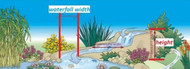
Which pump is right for your waterfall or stream? The two essential measurements are the width of the waterfall and the vertical lift from the pond water level to the waterfall outlet.
A successful waterfall depends on the flow delivered by the pump after the effects of height, pipe length, pipe diameter, fittings and connected equipment have been considered. The maximum flow printed on a pump is measured under little or no resistance and will not normally be the flow delivered by an installed system.
Quick waterfall flow calculation
For an average garden waterfall or watercourse, use the following rule of thumb:
Waterfall width in centimetres × 1.5 litres per minute = required flow in litres per minute.
This produces a moderate flow suitable for many natural-looking garden waterfalls. A shallow trickle may require less water, while a deep, powerful or formal sheet of water may require considerably more.
| Waterfall width | Required flow per minute | Required flow per hour |
|---|---|---|
| 30 cm | 45 litres/minute | 2,700 litres/hour |
| 50 cm | 75 litres/minute | 4,500 litres/hour |
| 80 cm | 120 litres/minute | 7,200 litres/hour |
| 100 cm | 150 litres/minute | 9,000 litres/hour |
| 150 cm | 225 litres/minute | 13,500 litres/hour |
Important: these figures are the flows required at the waterfall, not the pump’s maximum flow at zero head.

Measure the vertical lift
Measure vertically from the normal pond water level to the point where the water leaves the pipe at the top of the waterfall. This measurement is the static head.
Do not measure the length of the sloping stream or follow the route of the pipe when determining the vertical lift. Only the difference in elevation between the pond water level and the discharge point determines the static head.
The pipe length, diameter, bends, valves, filters and other restrictions create additional friction loss. Static head and friction loss together determine the system’s total operating head.
Maximum flow is not delivered flow
A pump described as delivering 10,000 litres per hour may only deliver that amount when it is operating with almost no lift or pipe resistance. As the operating head increases, the delivered flow decreases.
Select the pump using its performance curve or selection chart. Find the required flow on the chart at the installation’s estimated operating head—not at zero head.
For example, if a waterfall requires 7,200 litres per hour and has an operating head of approximately 1 metre, the chosen pump must deliver at least 7,200 litres per hour at 1 metre of head. A pump with a maximum rating of 7,200 litres per hour will be too small because its output will fall once installed.
Why pipe diameter matters
Water rubbing against the inside of the pipe creates resistance. The restriction becomes greater as the required flow increases, the pipe becomes longer or more bends and fittings are added.
Undersized pipe can substantially reduce the waterfall flow and waste energy. Increasing the pipe diameter can often provide more delivered water without increasing the pump’s electrical consumption.
When planning the installation, consider:
- The required waterfall flow
- The total pipe length
- The vertical lift
- The internal diameter of the pipe
- The number of bends, valves and fittings
- Any filter, UV clarifier or other equipment in the same circuit
Avoid unnecessary sharp bends and restrictions. Where practical, use gradual bends and a pipe diameter suitable for the intended flow rate.
Worked example: 80 cm waterfall
An 80 cm wide waterfall requires an estimated:
80 × 1.5 = 120 litres per minute
120 × 60 = 7,200 litres per hour
If the vertical lift is 1 metre, the pump must deliver approximately 7,200 litres per hour after the 1 metre lift and the pipework losses have been allowed for.
The correct choice is therefore not simply a pump labelled “7,200 litres per hour.” The pump-performance chart must show an output of at least 7,200 litres per hour at the calculated operating head.
OASE AquaMax Eco Classic selection
The following chart can be used to compare the delivered performance of OASE AquaMax Eco Classic pumps at different head heights.

Example: using the chart above, we can select an OASE AquaMax Eco Classic 8500 pump for a waterfall 800 mm wide at an operating head of 500 mm.
View our range of OASE AquaMax Eco Classic pumps.
Selecting pumps for larger waterfalls
Larger or higher waterfalls require considerably more flow and may need an OASE AquaMax Eco Twin or AquaMax Eco Expert pump. The selection must still be based on the flow available at the operating head.
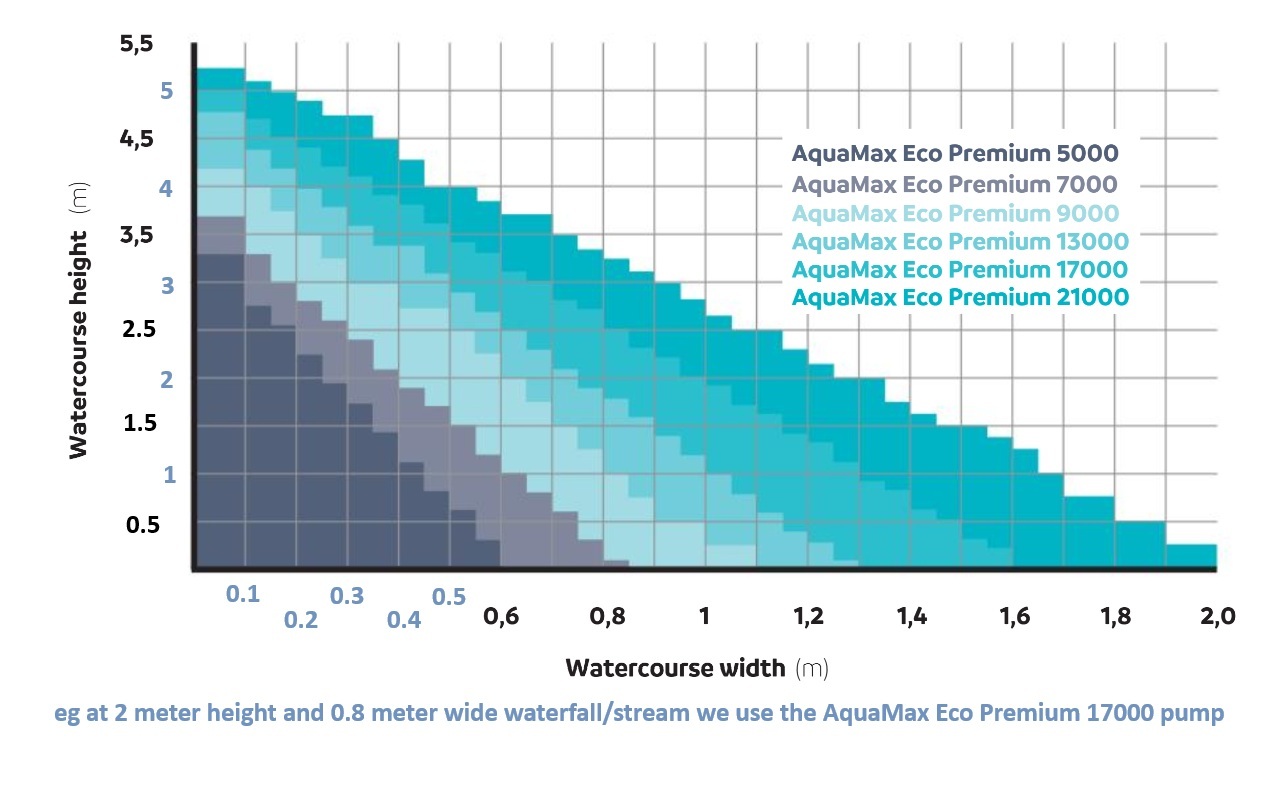

Example: using the chart above, we can select an OASE AquaMax Eco Twin 30,000 pump for a waterfall 800 mm wide at an operating head of 3,500 mm, or for a waterfall 2,200 mm wide at an operating head of 1,000 mm.

Example: using the chart above, we can select an OASE AquaMax Eco Expert 44,000 pump for a waterfall 4 metres wide at an operating head of 1 metre.
Browse our complete range of watercourse and filtration pumps.
Common waterfall pump-selection mistakes
- Selecting by maximum flow: the pump is chosen using its zero-head rating rather than its delivered flow at the operating head.
- Ignoring pipe resistance: long or undersized pipework reduces the delivered flow.
- Measuring along the slope: static head is the vertical difference in elevation, not the length of the stream.
- Forgetting connected equipment: filters, UV clarifiers, valves and fittings may add resistance.
- Choosing a pump with no reserve: there is no allowance for adjustment, changing conditions or normal system losses.
- Restricting the pump inlet: any required flow adjustment should normally be made on the discharge side, following the pump manufacturer’s instructions.
Frequently asked questions
Can I use the maximum flow stated on the pump?
No. Maximum flow is normally measured with little or no operating head. Use the flow shown on the pump-performance chart at the head height of your installation.
Should I choose a slightly larger pump?
A modest amount of additional capacity can be useful where the pump is controllable or the discharge flow can be adjusted correctly. Excessive oversizing wastes energy and can produce an unnatural result.
Does the pond filter affect the waterfall flow?
Yes. A filter, UV clarifier, valve or other restriction installed in the same circuit can reduce the delivered flow. Its resistance must be included when selecting the pump.
Can one pump operate both a filter and a waterfall?
It can, provided the complete system is designed for the required combined flow and operating head. Separate pumps may offer better control and allow the filtration system to continue operating when the waterfall is switched off.
Where should a flow-control valve be installed?
Where permitted by the pump manufacturer, flow is normally regulated on the discharge side of the pump. Do not restrict the pump inlet.
Need help choosing a pump?
If you are unsure, send Rockworld the waterfall width, vertical lift, approximate pipe length, proposed pipe diameter and details of any connected filter or UV clarifier.
Contact Rockworld for pump-selection advice or phone 045 870 970.