
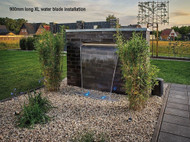
Waterfall Blade Installation & Design Guide
Published by Rockworld Water Features, Ireland on 24th Oct 2023
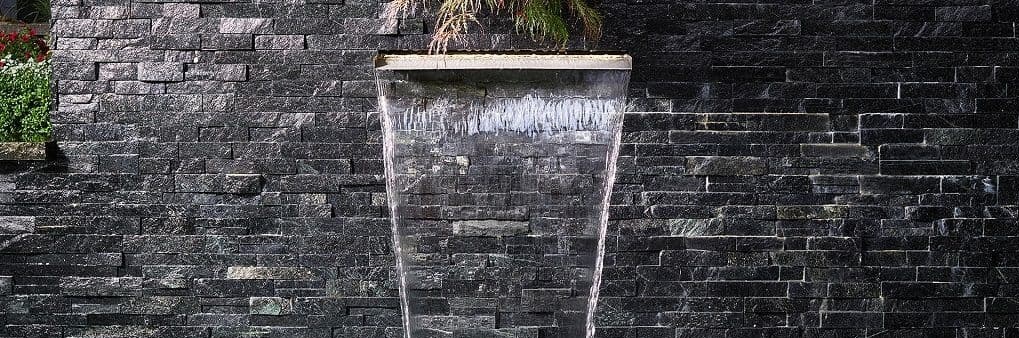

Start by choosing the blade width and deciding how high it will sit above the water. These measurements determine the required pump flow at the installation’s actual head height.
OASE waterfall blades are available in 300 mm, 600 mm and 900 mm widths. Each size is offered with either a standard 63 mm front lip or an extended 123 mm XL lip.
Installing an OASE waterfall blade
OASE water blades are manufactured from high-quality brushed stainless steel. Their dual inlets allow the pipework to enter from below or from the rear, making them suitable for a wide range of wall and reservoir designs.
The blade must be installed perfectly level to produce an even sheet of water across its full width. Pump output falls as the vertical lift and pipe resistance increase, so the pump must be selected for the required flow at the finished installation height—not simply by its maximum quoted flow rate.
The pump is normally positioned in the pond or reservoir and connected to the blade using suitable flexible hose or pipe. The reservoir must stand on a firm, level base and have adequate support around its sides and edges.
Use stainless-steel fixings and hose clips wherever practical. Make the blade and its connections accessible for inspection and maintenance rather than permanently sealing them inside the wall.
Waterfall blade lighting
Lighting the falling sheet of water creates an impressive evening effect. Submersible spotlights can illuminate the waterfall from below, while compatible LED strips can be fitted inside selected blades.

The installation above uses a stainless-steel blade concealed within a sandstone-clad wall, with submersible LED lighting illuminating the falling water.
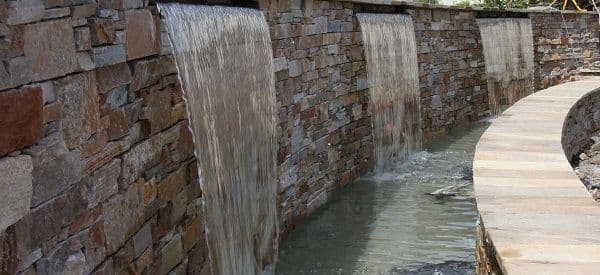
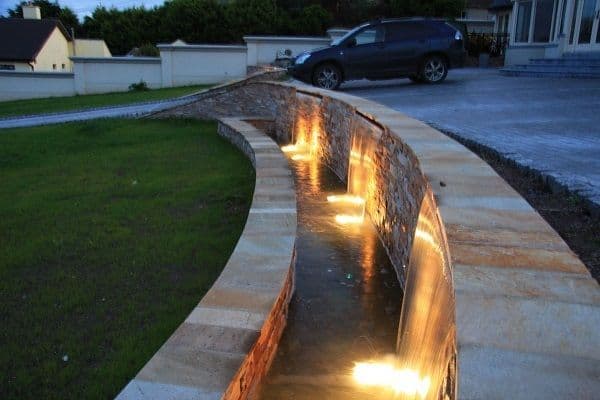
These two photographs show how lighting changes the appearance of the same waterfall-blade installation after dark.

This 900 mm XL OASE blade has a warm-white LED strip. The OASE Silent Splash system beneath the pebbles helps reduce splash and water noise.
Waterfall blade installation examples
Example 1: Raised pool and recessed blade
A raised pool provides an attractive sitting area, while the waterfall blade is recessed into the clad wall.

Example 2: Reservoir extending beneath the wall
Bringing the reservoir beneath the wall can simplify the pipe route and provide better access to the blade connection.


Example 3: Purpose-built reservoir
This example uses a purpose-built block reservoir on a firm, level base. The structure must be properly designed, supported and waterproofed before the waterfall equipment is installed.


Standard or XL waterfall blade?
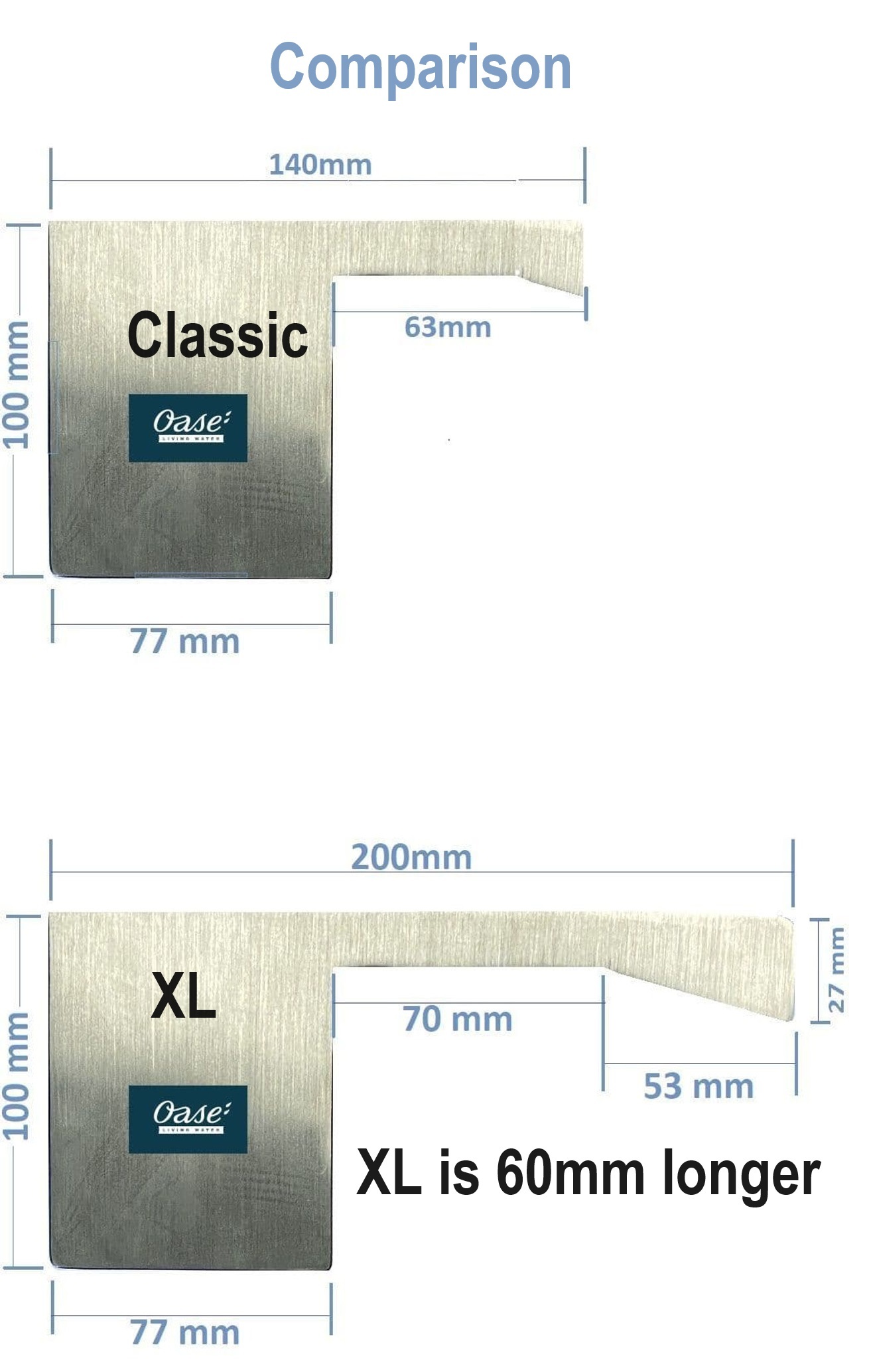
The functional difference is the length of the front lip. The standard blade projects approximately 63 mm, while the XL blade projects approximately 123 mm.
The longer XL lip is useful where the blade must extend farther beyond wall cladding before the water falls. The diagram below shows the difference in side profile.
Need help selecting the blade, pump or reservoir? Browse our waterfall blades, water walls and complete kits, or contact Rockworld with the blade width, waterfall height, pipe length and intended reservoir dimensions.