
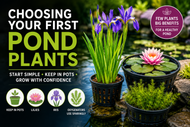
Choosing Pond Plants for Your First Garden Pond
Published by Rockworld Water Features, Ireland on 2nd Sep 2026
Choosing Your First Pond Plants – Start Simple
Adding plants is one of the most enjoyable parts of creating a new garden pond. They soften the edges, add colour and interest, provide cover for wildlife and help a new pond begin to look established.
But one of the most common mistakes with a new pond is simply adding too many plants too soon.
A pond can change considerably during its first year, so our advice for a first pond is simple: start with a few well-chosen plants, keep them contained in pots or planting baskets, and see how they perform before adding more.
You Don't Need to Fill the Pond with Plants
Garden centres often display pond plants in large groups, which can give the impression that a new pond needs dozens of plants from the outset. It doesn't.
Aquatic plants can grow remarkably quickly once established. A plant that looks quite small in its pot in spring can occupy a substantial area by midsummer.
Start with a small selection and give them a growing season. You can always add more later. Removing an established plant that has taken over the pond is considerably more difficult.
Keep Pond Plants in Pots or Aquatic Baskets
For most garden ponds, we recommend keeping plants in aquatic pots or planting baskets rather than planting directly into gravel, soil or other material on the pond floor.
This makes the pond much easier to manage.
Potted plants can be moved to a different depth, lifted for trimming or dividing, removed if they become invasive and repositioned as the pond develops.
It also helps prevent vigorous root systems spreading throughout the pond.
As a general rule, don't make pond maintenance more difficult than it needs to be. Keeping plants contained gives you much more control.
Iris – An Excellent Plant for the Pond Edge
Iris can be an excellent choice for a first pond, particularly around shelves and margins.
They provide attractive upright foliage and, depending on the variety, impressive flowers. Their vertical growth also gives a useful contrast to lower-growing marginal plants and floating lily leaves.
Check the recommended planting depth for the particular iris you buy. Different varieties have different requirements, and not every plant sold as an iris is intended to sit at the same water depth.
Keep the plant in an aquatic basket so that its growth can be controlled and the plant can be lifted and divided when necessary.
Water Lilies – Start with One
A water lily is probably the classic pond plant and is an excellent addition to many garden ponds.
However, choose the variety according to the size and depth of your pond.
Different lilies have very different eventual spreads. A variety suitable for a small pond may remain relatively compact, while a vigorous variety can eventually cover a substantial area of water.
For a typical new garden pond, one correctly selected lily is often a much better starting point than several.
Keep the lily in its planting basket and position it at the recommended depth. If necessary, it can initially be placed on a raised support and lowered as it becomes established.
Remember that those few attractive leaves you bring home from the garden centre are not necessarily an indication of how large the plant will eventually become.
Be Particularly Careful with Oxygenating Plants
Oxygenating plants are commonly recommended for ponds and can certainly be useful, but the term "oxygenator" sometimes creates the impression that the more you add, the better the pond will be.
That isn't necessarily the case.
Some oxygenating plants are extremely vigorous. Under suitable conditions they can spread rapidly and produce a dense mass of vegetation.
Once an oxygenator has spread throughout a pond, removing it can become an ongoing maintenance job. Small pieces of some species can also establish elsewhere in the pond.
Start with a small quantity and observe how it grows.
It is much easier to add another pot or bunch later than to remove wheelbarrows of unwanted growth.
Before Putting Any New Plant into Your Pond
Don't take a plant directly from the garden-centre shelf and immediately drop it into your pond.
Inspect it carefully first.
Aquatic plants can arrive with algae, duckweed, unwanted plant material, snails, eggs, larvae or other organisms amongst the leaves, roots and planting media.
Remove anything growing in the pot that you did not deliberately buy.
A tiny piece of an unwanted aquatic plant may look insignificant at the time but can become a permanent resident of your pond.
Pay particular attention to duckweed and other small floating plants. Once introduced, they can be extremely difficult to eradicate completely.
Soak and Rinse New Pond Plants First
We recommend soaking new aquatic plants separately before introducing them to your pond, particularly plants purchased from a general garden centre.
Use a clean container filled with suitable fresh water and keep the new plants isolated from the pond initially. Inspect the water and plants during this period and rinse the foliage and outside of the pots thoroughly.
This gives you another opportunity to spot unwanted hitchhikers before they enter the pond.
Do not automatically use pesticides, household disinfectants or other chemicals to "sterilise" aquatic plants. Residues can potentially harm fish and other pond life.
The objective is not to make the plant sterile. It is to avoid accidentally introducing something you never intended to put into your pond.
A Good First Selection
For a new garden pond, you don't need a complicated planting scheme.
A sensible starting point might simply be one appropriately sized water lily, one or two attractive marginal plants such as iris, and a modest amount of suitable oxygenating plant.
Then stop.
Allow the plants to establish and watch what happens over the first growing season. Consider how much sunlight the pond receives, how quickly each plant grows and how much open water you want to retain.
You can then add plants because the pond actually needs them rather than because there happened to be an empty space when you first built it.
Less Is Often Better
A new pond doesn't have to look mature immediately.
Plants grow.
Starting with fewer plants, keeping them contained and choosing varieties appropriate to the size of the pond will usually produce a pond that is considerably easier to maintain in the long term.
Most importantly, inspect, soak and rinse every new aquatic plant before introducing it to your pond, and remove anything else you find growing in the pot.
With pond plants, what you don't introduce can sometimes be just as important as what you do.